Voice of the Voiceless: How we worked together to create materials to help reduce stigma for people receiving opioid substitution therapy in pharmacies
By Dr Vicky Carlisle, Research Fellow, Bristol Medical School, University of Bristol
What is the ‘Voice of the Voiceless’?
Voice of the Voiceless is a collaboration between people who receive opioid substitution therapy (OST) for opioid dependence, University of Bristol academics (Dr Vicky Carlisle, Dr Adam Holland, Dr Jenny Scott), Bristol City Council (Ashley Ward), Bristol Drugs Project (Lydia Plant, Lianna Telfer), Developing Health & Independence (Nick Booth), and Harm Reduction Mothers2Mothers (Anna Millington).
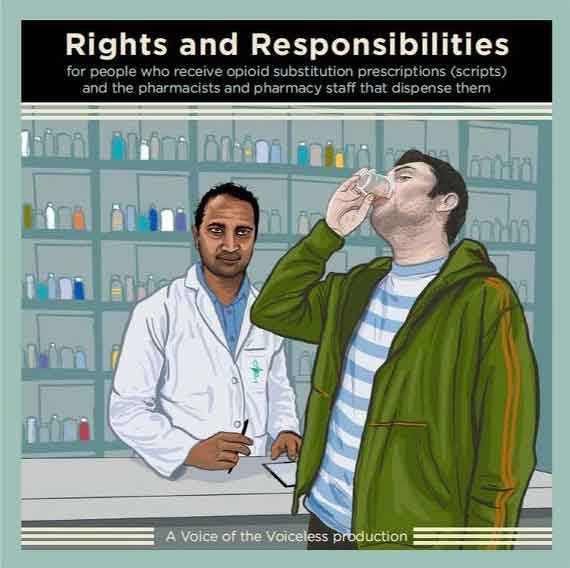
In 2024 we worked together with a graphic designer to co-produce a booklet that aims to: ‘reduce stigma for people who receive opioid substitution treatment; empower them in their interactions in pharmacies; and foster mutual compassion and respect between pharmacy staff and people who receive OST.’
What is OST?
OST (with methadone or buprenorphine) is prescribed for opioid dependence. Broadly, the aim is to provide individuals with stability and relief from withdrawal symptoms, and to reduce reliance on street drugs. OST is associated with a range of benefits, including a reduction in the transmission of Hepatitis C and HIV, improved physical and mental health, improvements in quality of life, and more stable living circumstances. OST is also highly effective in reducing drug related deaths, which are at record levels in England.
What is the connection between stigma and pharmacies?
The benefits of OST are undermined by barriers to retention and engagement with estimates suggesting that only about half of people who may benefit from OST are receiving it in England.
Stigma is cited as a key barrier to these services.
Pharmacy staff have often received little training in how to interact with people in receipt of OST, many of whom who have experienced trauma and exclusion. People who are prescribed OST often must attend a pharmacy daily and, at least at first, are usually supervised consuming their dose.
Therefore, to maximise engagement and retention in OST, it is vital that interventions are developed which address the stigma that people who receive OST experience, including that experienced in pharmacies.
How did the Voice of the Voiceless project begin?
In Bristol, May 2023, we ran a full day workshop for thirteen people with lived experience of stigma related to their drug use and fourteen professionals working across drugs services and other, related sectors in Bristol.
Jose Barco, professional facilitator, expertly led several activities throughout the day, which resulted in us collaboratively identifying policy, practice and research needs in relation to stigma towards people who use drugs in Bristol. ‘Stigma in pharmacies in relation to receiving OST’ was identified as a key issue to address, which led to the Voice of the Voiceless project.
Three stages to creating the Voice of the Voiceless
Following the initial workshop, we subsequently ran three in-person workshops between February and July 2024 with people with lived experience, academics and pharmacy staff.
We adopted the following principles of co-production, as recommended by NIHR INVOLVE:
sharing of power– the research is jointly owned, and people work together to achieve a joint understanding
including all perspectives and skills– ensuring the research team includes all those who can make a contribution
respecting and valuing the knowledge of all those working together on the research – everyone is of equal importance
reciprocity – everybody benefits from working together
building and maintaining relationships– an emphasis on relationships is key to sharing power.
Workshop One

The roundhouse at Chew Magna Community Farm – the setting for the first workshop
The first workshop took place at The Community Farm, near Chew Magna. This was a beautiful setting for everyone to get to know each other, to build trust and develop shared understandings for the work.
We used a wood burner, marshmallows, lots of tea and (a now legendary) carrot cake to help everyone intregrate. At the end of the first session, we had sketched out an idea for what we wanted to achieve by the end of the project and also had a chance to discuss positive and negative experiences of receiving OST in pharmacies. Most importantly, we all really bonded and felt like a team.
Workshop Two

Co-producing the content of the booklet at the second workshop
During the second session at Barton Hill Micro-campus, we focussed on the content of the booklet. One of the lived experience members suggested the name ‘Voice of the Voiceless’ for the group, which we all felt powerfully illustrated what we were trying to achieve and how the group saw themselves previously.
The group felt that it was important to represent both positive and negative experiences as, when care was good, it was noted to have a hugely positive impact. The lived experience members chose to share their stories as vignettes in the booklet, and these were interspersed with ‘rights and responsibilities’ for both pharmacy staff and people who receive OST. The aims of this were to:
empower people who receive OST to be able to advocate for themselves and the services they receive and to overcome internalised stigma and shame.
help people who receive OST to understand the legal restrictions on the medications and why pharmacies need to provide them in the way they do (for instance issues around the supply of controlled drugs)
foster mutual respect and compassion between people who receive OST and the pharmacy staff who interact with them
reduce stigmatising attitudes towards people who receive OST.
We communicated the style and content to the graphic designer, who then produced proofs for us to look at during the final, in-person session.
Workshop Three
During the third and final workshop, we refined the content of the booklet and the images. These were then shared with the group via email until we had an agreed draft.
Reflections and next steps
Participants described the co-production process as empowering and inclusive. Getting out of the city for the first workshop was particularly valued and the relaxed, informal setting really helped the group to bond. Everyone felt proud of the final output and were keen to stay connected to work on future projects.
The booklet is now being disseminated across the United Kingdom, with plans to evaluate its impact and explore further training and engagement opportunities.